How it works
You write. Nothing leaves. It comes back.
Every other women's health app asks you to translate your life into its forms: pick a flow level, tap a symptom, rate your mood out of five. You end up with a database that knows what you tapped and nothing about what happened — and an app you open to report on yourself. Three weeks a month it has nothing to say to you.
Narvita works the other way round. It has no fixed set of things it measures. It picks up what you actually say and builds around that, so what it follows for you is not what it follows for anyone else — your cycle is one of the things that falls out of keeping a journal, not the reason to keep one. All of the understanding happens in the app on your phone: there is no server anywhere that has read a word of your journal, because there is no copy of it to read.
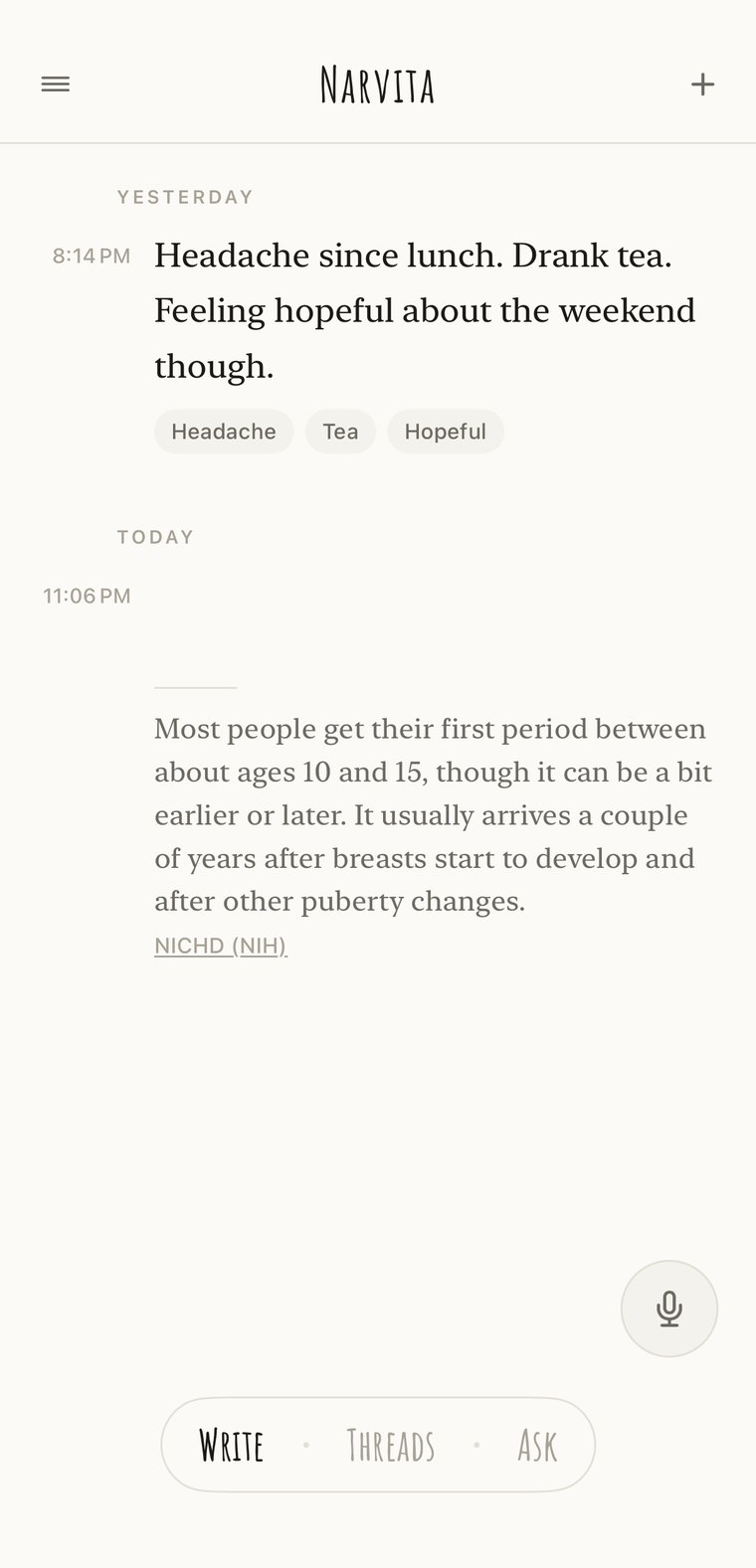
Write like it's a blank page
Because it is one. No fields, no chips, no required anything. Underneath what you wrote, a quiet line shows what your phone made of it — tap any of it to see the exact sentence it came from, or to say it's wrong. Speak instead of typing if you'd rather; that's transcribed on the device too.
It grows the threads you actually have
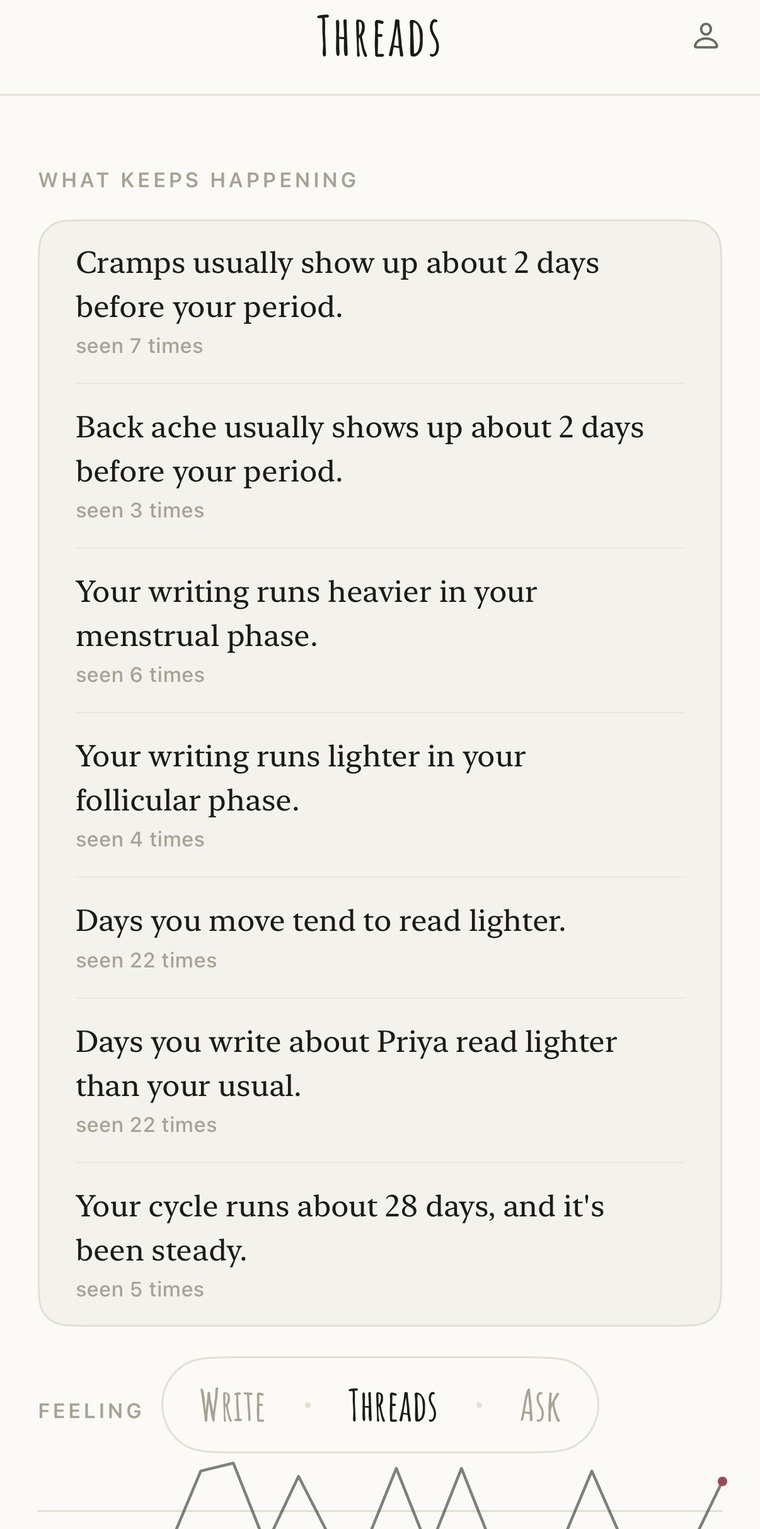
Narvita ships with no fixed set of things to measure. Write about your sister, your thesis, a diagnosis, a dog, and each becomes its own thread once it has turned up on enough separate days to be more than a passing mention. Nothing sits at the top because we decided it should: the page is ordered by what you write about, and it reorders itself as you change. If you write about your period, your cycle is one of those threads — it learns your real average instead of assuming 28 days, and it says how many times it has seen something before it will call it a pattern. If you never write about it, that section simply isn't there.
It knows what season you're in
Every cycle app says the same thing to every woman: your period is four days late. To someone who is pregnant that's nonsense. To someone trying to conceive it's the cruellest possible phrasing of the thing she's already counting. To someone who miscarried last week it is unbearable. To someone in perimenopause it's simply wrong — her cycles aren't late, they're changing.
Write "I'm pregnant", or "we're trying", or that you lost a pregnancy, and Narvita changes what it says and what it asks. After a loss it stops asking about your cycle entirely for a while. It never guesses at any of this — a late period is never read as a pregnancy — and whatever it concluded is one tap away in Settings.
It remembers so you don't have to
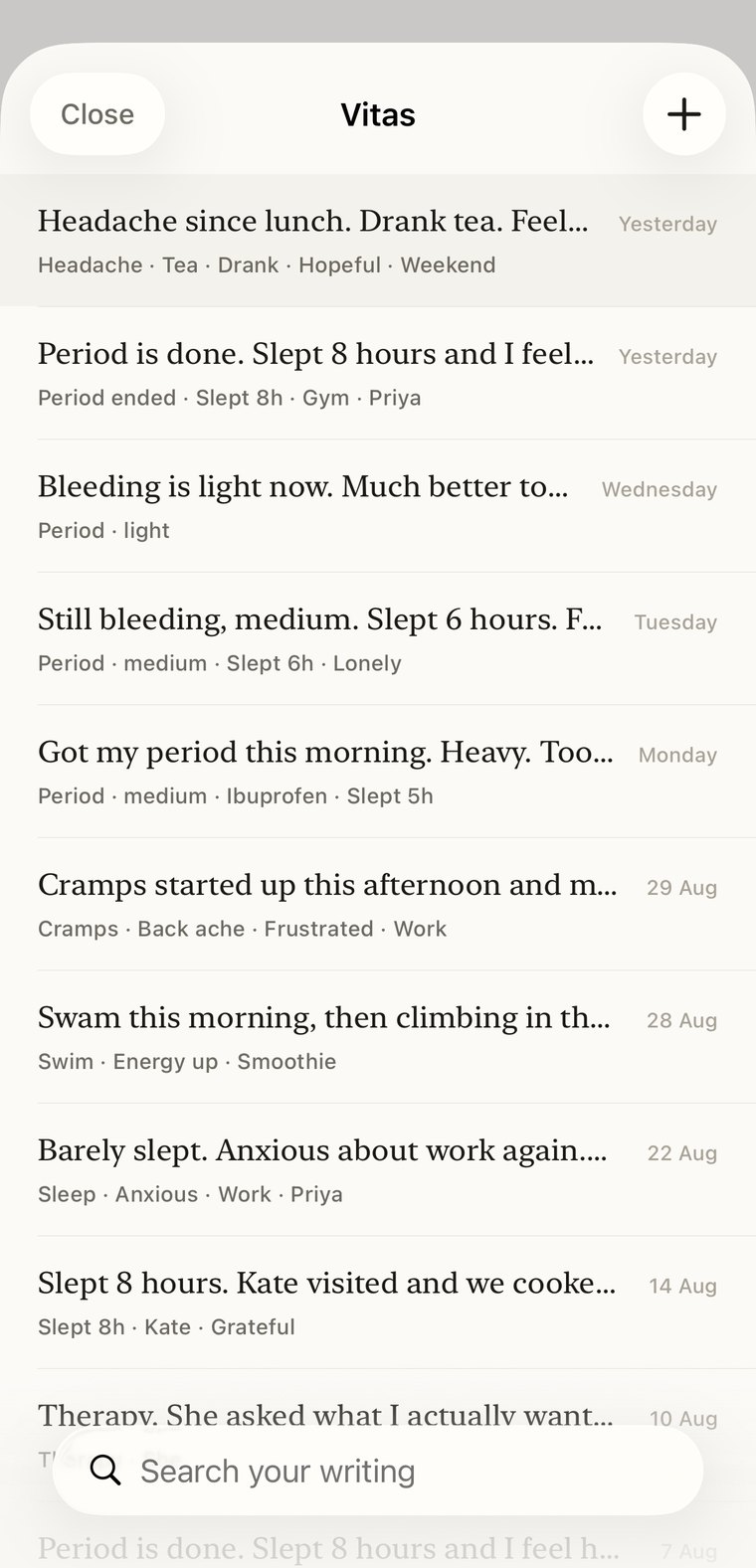
"Pick the kids up in two hours" becomes a reminder in two hours. "I need to book the smear test" gets asked about once, later, in your own words. And once you mention a period, it quietly checks in — still bleeding? — and asks again weeks later, on your own rhythm, when one is due.
It hands your own words back
A year ago today, you wrote this. And the thing no general journal can do: the last time you were around day 24, you wrote this. Put a date in — "presentation on the 14th" — and it tells you where that lands in your cycle, and what you've written the last few times you were there, with the count attached.
Women are told constantly that what they feel is unpredictable. Your own writing, laid against your own cycle, says otherwise: it's a week you've had before, and survived. That turns a hard stretch from evidence that something's wrong with you into something you can plan around.
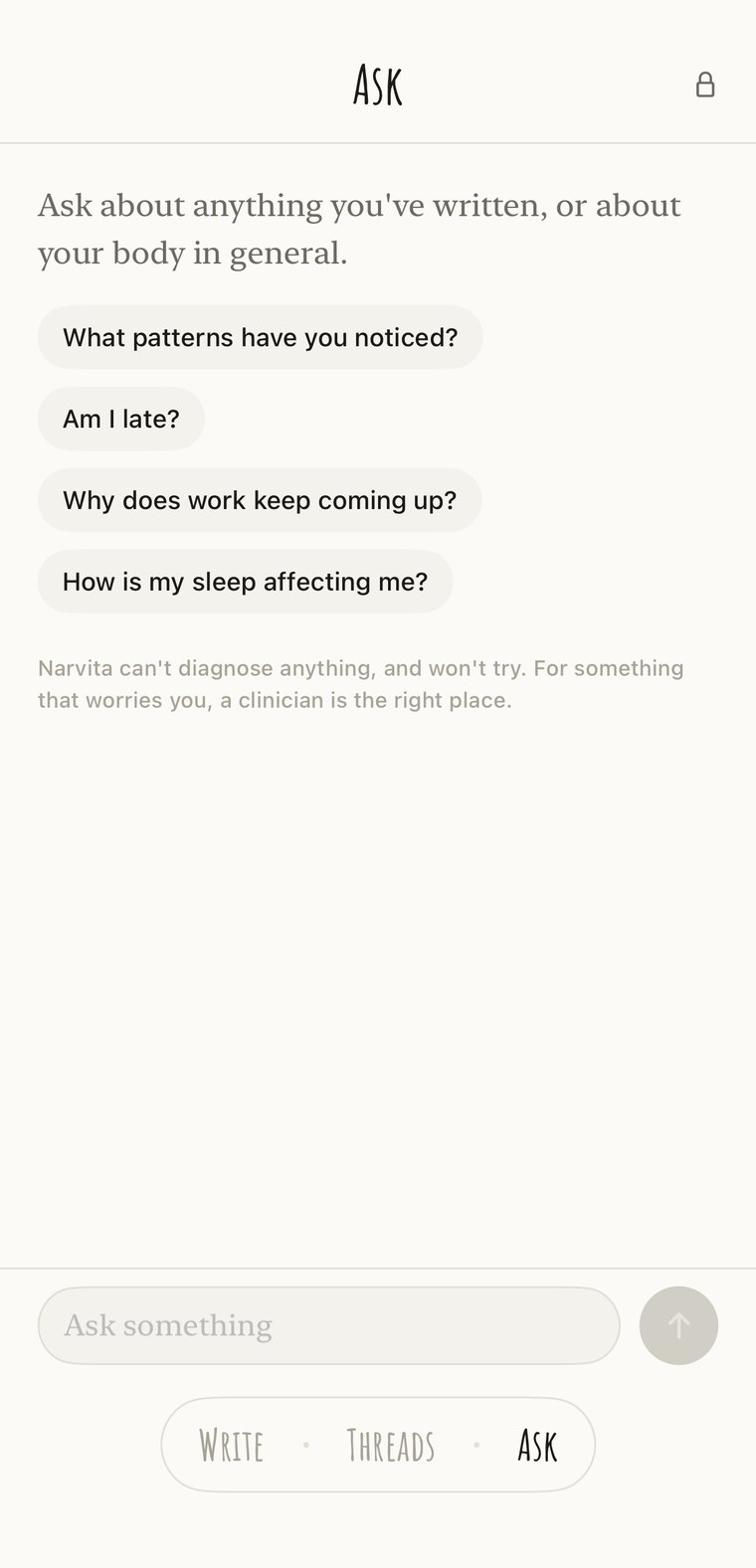
Ask it anything
Am I late? What have I been writing about most? When did I last feel like this? — answered on your phone, by a model running on the device, from your own entries. Ask something medical and it declines and points you at a real source, because a journal isn't a clinician. Nothing you ask leaves the phone.